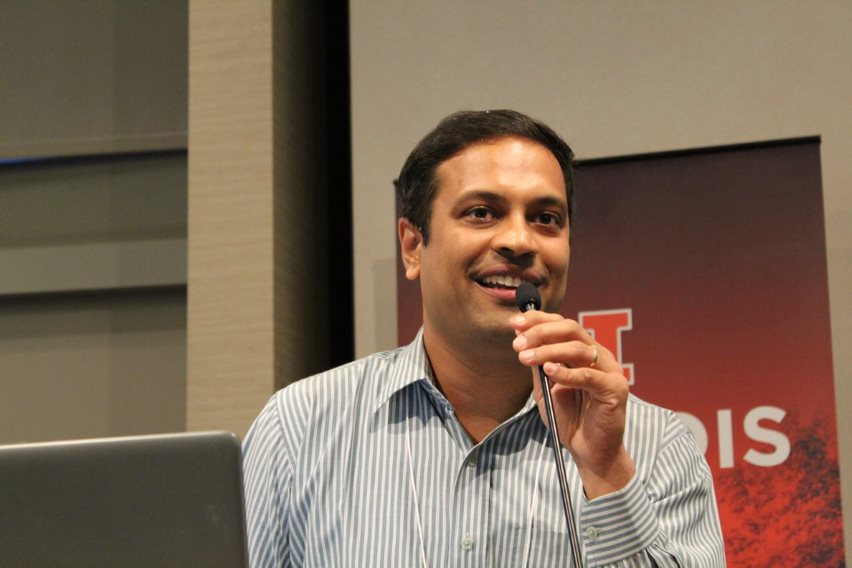
As a natural generalization of the Euler's constant $\gamma$, Y. Ihara introduced the Euler-Kronecker constants attached to any number field. In this talk, we will discuss the connection between these constants and certain arithmetic properties of number fields.
Euler's
remarkable formula for $\zeta(2m)$ immediately tells us that even zeta
values are transcendental. However, the algebraic nature of odd zeta
values is yet to be determined. Page 320 and 332 of Ramanujan's
Lost Notebook contains an intriguing identity for $\zeta(2m+1)$ and
$\zeta(1/2)$, respectively. Many mathematicians have studied these
identities over the years.
In
this talk, we shall discuss transformation formulas for a certain
infinite series, which will enable us to derive Ramanujan's formula for
$\zeta(1/2),$ Wigert's formula for $\zeta(1/k)$, as well as Ramanujan's
formula for $\zeta(2m+1)$. We also obtain a new identity for
$\zeta(-1/2)$ in the spirit of Ramanujan.
Abstract: Finding
solutions of differential equations has been a problem in pure
mathematics since the invention of calculus by Newton and Leibniz in the
17th century. Bessel functions are solutions of a particular
differential equation, called Bessel’s equation. In classical analytic
number theory, there are several summation formulas or trace formulas
involving Bessel functions. Two prominent such are the Kuznetsov trace
formula and the Voronoi summation formula. In this talk, I will present some Voronoi type summation formulas and its application to Number theory.
Abstract:Theta series first appeared in Euler’s work on partitions, but was systematically studied later by Jacobi. In his Lost Notebook, Ramanujan wrote down many identities (without proof) involving the so-called partial theta series. Unlike the theta series which are modular forms, the theory of partial theta series is not well understood. In this talk, I will consider a family of partial theta series and show their “quantum modular” behaviour. This is based on my recent joint work with Robert Osburn (UCD).
The talk should be accessible to graduate and advanced undergraduate students.
The next speaker in our series is Siddhi Pathak, S. Chowla Research Assistant Professor, Penn State University. The talk announcement is below.
Talk Announcement:
Title:Special values of L-functions
Speaker: Siddhi Pathak (Penn State)
When: May 13, 2021 - 3:55 PM - 5:00 PM (IST)
Where:Zoom (the link will be sent by email to our list)
Live link: https://youtu.be/SXl9IPgE2aI
Tea or Coffee: Please bring your own.
Abstract:In 1730s, Euler resolved the famous Basel problem by evaluating values of the Riemann zeta-function at even positive integers as rational multiples of powers of pi. Thus, we recognize that the values \zeta(2k) are transcendental and algebraically dependent. The situation is drastically different for odd zeta-values, that are not only expected to be transcendental, but also algebraically independent. Although we are far from proving this, there has been striking progress in the work of Apery, and more recently by Ball-Rivoal, Zudilin and others. In this talk, we discuss the analogous problem for Dirichlet L-functions, more generally, Dirichlet series with periodic coefficients.
This talk will be accessible to graduate students.
Where: Zoom: Please write to sf-and-nt@gmail.com for the link.
Tea or Coffee: Please bring your own.
Abstract:We show that the series expansions of certain $q$-products have \textit{matching coefficients} with their inverses. Several of the results are associated to Ramanujan's continued fractions. For example, let $R(q)$ denote the Rogers-Ramanujan continued fraction having the well-known $q$-product repesentation $R(q)=\left(q,q^4;q^5\right)_{\infty}/\left(q^2,q^3;q^5\right)_{\infty}$. If \begin{align*} \sum_{n=0}^{\infty}\alpha(n)q^n=\dfrac{1}{R^5\left(q\right)}=\left(\sum_{n=0}^{\infty}\alpha^{\prime}(n)q^n\right)^{-1},\\ \sum_{n=0}^{\infty}\beta(n)q^n=\dfrac{R(q)}{R\left(q^{16}\right)}=\left(\sum_{n=0}^{\infty}\beta^{\prime}(n)q^n\right)^{-1}, \end{align*} then \begin{align*} \alpha(5n+r)&=-\alpha^{\prime}(5n+r-2), \quad r\in\{3,4\}; \\ \text{and} & \\ \beta(10n+r)&=-\beta^{\prime}(10n+r-6), \quad r\in\{7,9\}. \end{align*} This is a joint work with Hirakjyoti Das.
The next speaker in our seminar is Shishuo Fu of Chongqing University, PRC. It may be Fool's day, but we're not kidding. It really is Shishuo who has consented to give a talk all the way from China!
The live broadcast did not work as anticipated in the previous talk; I hope it works this time. At any rate, its best to try and come for the zoom session.
Talk Announcement
Title: Bijective recurrences for Schroeder triangles and Comtet statistics
Speaker: Shishuo Fu (Chongqing University, PRC)
When: April 1, 2021 - 3:55 PM - 5:00 PM (IST)
Where: Zoom: Please write to sfandnt@gmail.com for a link
Tea or Coffee: Please bring your own.
Abstract:
In this talk, we bijectively establish recurrence relations for two triangular arrays, relying on their interpretations in terms of Schroeder paths (resp. little Schroeder paths) with given length and number of hills. The row sums of these two triangles produce the large (resp. little) Schroeder numbers. On the other hand, it is well-known that the large Schroeder numbers also enumerate separable permutations. This propelled us to reveal the connection with a lesser-known permutation statistic, called initial ascending run (iar), whose distribution on separable permutations is shown to be given by the first triangle as well. A by-product of this result is that "iar" is equidistributed over separable permutations with "comp", the number of components of a permutation. We call such statistics Comtet and we briefly mention further work concerning Comtet statistics on various classes of pattern avoiding permutations. The talk is based on joint work with Zhicong Lin and Yaling Wang.
The next talk is by Christian Krattenthaler. I hope this time the live broadcast works. Here is the announcement.
Talk announcement
Title: Determinant identities for moments of orthogonal polynomials
Speaker: Christian Krattenthaler (University of Vienna, Austria)
When: March 18, 2021 - 3:55 PM - 5:00 PM (IST)
Where: Zoom: Please write to sfandnt@gmail.com for a link
Tea or Coffee: Please bring your own.
Abstract: We present a formula that expresses the Hankel determinants of a linear combination of length d+1 of moments of orthogonal polynomials in terms of a d x d determinant of the orthogonal polynomials. As a literature search revealed, this formula exists somehow hidden in the folklore of the theory of orthogonal polynomials as it is related to "Christoffel's theorem". In any case, it deserves to be better known and be presented correctly and with full proof. (During the talk I will explain the meaning of these somewhat cryptic formulations.) Subsequently, I will show an application of the formula. I will close the talk by presenting a generalisation that is inspired by Uvarov's formula for the orthogonal polynomials of rationally related densities.
We are happy to report that Atul Dixit, one of the co-organizers of this seminar, has been awarded the 2021 Gábor Szegö Prize. This prize is awarded every two years by the SIAM Activity Group on Orthogonal Polynomials and Special Functions
(SIAG/OPSF). It is awarded to an
early-career researcher for outstanding research contributions within 10 years of obtaining a Ph.D.
The
selection committee for the 2021 award consists of Peter Clarkson
(Chair), University of Kent; Kerstin Jordaan, University of South
Africa; Adri Olde Daalhuis, The University of Edinburgh; Sarah Post,
University of Hawaii; and Yuan Xu, University of Oregon.
The selection committee in its letter to him cited his “impressive scientific work solving problems related to number theory using special functions, in particular related to the work of Ramanujan.”
Atul obtained his Ph.D. under the direction of Bruce Berndt in 2012 from the University of Illinois at Urbana-Champaign. Subsequently he did a post-doc at Tulane with Victor Moll as his mentor. Currently, he is in IIT, Gandhinagar and has quickly developed a reputation among young and upcoming mathematicians in this country that has attracted a bright set of Ph.D. students and post-docs to his team.
We wish Atul continued success, both personally and for the group he is leading.
Gaurav Bhatnagar and Krishnan Rajkumar (co-organizers with Atul of this seminar).
Abstract: We study the parity of coefficients of classical mock theta functions. Suppose $g$ is a formal power series with integer coefficients, and let $c(g;n)$ be the coefficient of $q^n$ in its series expansion. We say that $g$ is of parity type $(a,1-a)$ if $c(g;n)$ takes even values with probability $a$ for $n\geq 0$. We show that among the 44 classical mock theta functions, 21 of them are of parity type $(1,0)$. We further conjecture that 19 mock theta functions are of parity type $(\frac{1}{2},\frac{1}{2})$ and 4 functions are of parity type $(\frac{3}{4},\frac{1}{4})$. We also give characterizations of $n$ such that $c(g;n)$ is odd for the mock theta functions of parity type $(1,0)$.
Where: Google Meet: Please write to sfandnt@gmail.com for a link.
Tea or Coffee: Please bring your own.
ABSTRACT
We
develop a calculus that gives an elementary approach to enumerate
partition-like objects using an infinite upper-triangular
number-theoretic matrix. We call this matrix the Partition-Frequency
Enumeration (PFE) matrix. This matrix unifies a large number of results
connecting number-theoretic functions to partition-type functions. The
calculus is extended to arbitrary generating functions, and functions
with Weierstrass products. As a by-product, we recover (and extend) some
well-known recurrence relations for many number-theoretic functions,
including the sum of divisors function, Ramanujan's $\tau$ function,
sums of squares and triangular numbers, and for $\zeta(2n)$, where $n$
is a positive integer. These include classical results due to Euler,
Ramanujan, and others. As one application, we embed Ramanujan's famous
congruences $p(5n+4)\equiv 0\;$ (mod $5)$ and $\tau(5n+5)\equiv 0\; $
(mod $5)$ into an infinite family of such congruences.
The next talk will be by Victor Moll of Tulane University. This will be the first mathematician from the US giving a talk in our seminar. Victor has kindly consented to stay awake to make his talk more suitable for Indian timings. But in future, we do expect speakers from the US will speak at times later at night (IST).
At any rate, we hope more speakers from the US will give talks in our seminar. As we have mentioned earlier, our website now contains video recordings of the presentations. This makes it more convenient for the US participants to view the talks.
Talk Announcement
Title: Valuations of interesting sequences
Speaker: Victor Moll (Tulane)
When: February 4, 2021 - 3:55 PM - 5:00 PM (IST)
Where: Google Meet; Please write to sfandnt@gmail.com if you want a link.
Tea or Coffee: Please bring your own.
ABSTRACT
Given a sequence ${ a_{n} }$ of integers and a prime $p$, the sequence of
valuation $\nu_{p}(a_{n})$ presents interesting challenges. This talk will discuss a
variety of examples in order to illustrate these challenges and present our approach