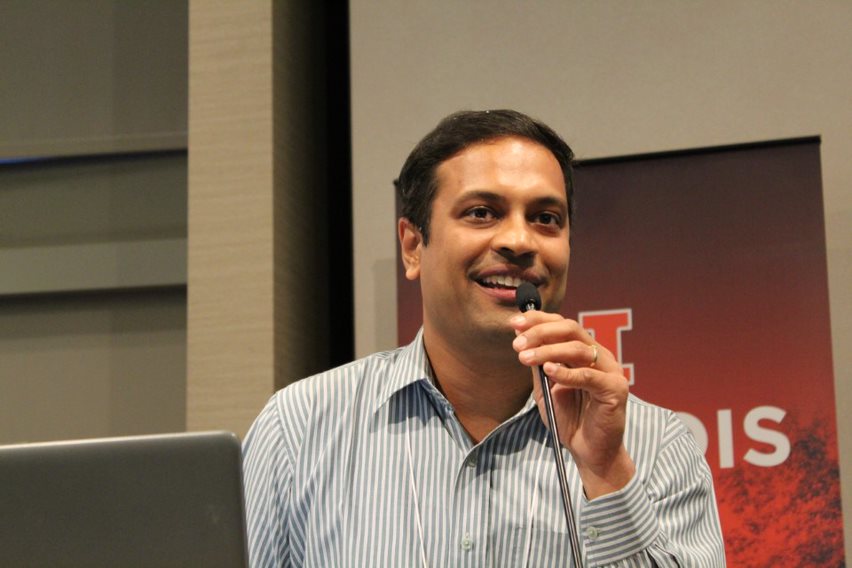
Thursday, August 5, 2021

Peter A. Clarkson (University of Kent, UK) - Thursday, Aug 5, 2021 - 3:55 PM - 5:00 PM (IST)


The next speaker in our seminar is Professor Peter Clarkson of the University of Kent, Canterbury, UK. 

Here is the announcement.

Talk Announcement:

Title: Special polynomials associated with the Painlevé equations
Speaker: Peter A. Clarkson (University of Kent, UK)
 
When: Thursday, Aug 5, 2021 - 3:55 PM - 5:00 PM (IST)

Where: Zoom  (Please write at sfandnt@gmail.com for a link)
 

Tea or Coffee: Please bring your own.

Abstract:  

The six Painlevé equations, whose solutions are called the Painlevé transcendents, were derived by Painlevé and his colleagues in the late 19th and early 20th centuries in a classification of second order ordinary differential equations whose solutions have no movable critical points.
In the 18th and 19th centuries, the classical special functions such as Bessel, Airy, Legendre and hypergeometric functions, were recognized and developed in response to the problems of the day in electromagnetism, acoustics, hydrodynamics, elasticity and many other areas.
Around the middle of the 20th century, as science and engineering continued to expand in new directions, a new class of functions, the Painlevé functions, started to appear in applications. The list of problems now known to be described by the Painlevé equations is large, varied and expanding rapidly. The list includes, at one end, the scattering of neutrons off heavy nuclei, and at the other, the distribution of the zeros of the Riemann-zeta function on the critical line $\mbox{Re}(z) =\tfrac12$. Amongst many others, there is random matrix theory, the asymptotic theory of orthogonal polynomials, self-similar solutions of integrable equations, combinatorial problems such as the longest increasing subsequence problem, tiling problems, multivariate statistics in the important asymptotic regime where the number of variables and the number of samples are comparable and large, and also random growth problems.

The Painlevé equations possess a plethora of interesting properties including a Hamiltonian structure and associated isomonodromy problems, which express the Painlevé equations as the compatibility condition of two linear systems. Solutions of the Painlevé equations have some interesting asymptotics which are useful in applications. They possess hierarchies of rational solutions and one-parameter families of solutions expressible in terms of the classical special functions, for special values of the parameters. Further the Painlevé equations admit symmetries under affine Weyl groups which are related to the associated Bäcklund transformations.

In this talk I shall discuss special polynomials associated with rational solutions of Painlevé equations. Although the general solutions of the six Painlevé equations are transcendental, all except the first Painlevé equation possess rational solutions for certain values of the parameters. These solutions are expressed in terms of special polynomials. The roots of these special polynomials are highly symmetric in the complex plane and speculated to be of interest to number theorists. The polynomials arise in applications such as random matrix theory, vortex dynamics, in supersymmetric quantum mechanics, as coefficients of recurrence relations for semi-classical orthogonal polynomials and are examples of exceptional orthogonal polynomials.


Saturday, July 17, 2021

Anup Dixit (IMSc, Chennai) - July 22, 2021 - 3:55 PM - 5:00 PM (IST)

The next speaker in the SF and NT Seminar is Anup Biswanath Dixit of IMSc. (Chennai). Here is the announcement.

Talk Announcement:

Title: On Euler-Kronecker constants and the class number problem
Speaker: Anup Dixit (IMSc, Chennai)
 
When: Thursday, July 22, 2021 - 3:55 PM - 5:00 PM (IST)

Where: Zoom (please send email to sfandnt@gmail.com for a link)
 

Tea or Coffee: Please bring your own.

 
Abstract:  

As a natural generalization of the Euler's constant 
$\gamma$, Y. Ihara introduced the Euler-Kronecker constants attached 
to any number field. In this talk, we will discuss the connection 
between these constants and certain arithmetic properties of number 
fields.

Thursday, July 8, 2021

Bibekananda Maji (IIT, Indore) - July 8, 2021 - 3:55 PM - 5:00 PM (IST)

 Dear all,


The next talk is by Bibekananda Maji of IIT, Indore. Here is the announcement.

Talk Announcement:

Title: On Ramanujan's formula for $\zeta(1/2)$ and $\zeta(2m+1)$

Speaker: Bibekananda Maji (IIT, Indore)
 
When: Thursday, July 8, 2021 - 3:55 PM - 5:00 PM (IST)

Where: Zoom (please send email to sfandnt@gmail.com for a link)
 

Tea or Coffee: Please bring your own.


Abstract: 
Euler's remarkable formula for $\zeta(2m)$ immediately tells us that even zeta values are transcendental. However, the algebraic nature of odd zeta values is yet to be determined.  Page 320 and 332 of Ramanujan's Lost Notebook contains an intriguing identity for $\zeta(2m+1)$ and $\zeta(1/2)$, respectively.  Many mathematicians have studied these identities over the years.

In this talk, we shall discuss transformation formulas for a certain infinite series,  which will enable us to derive Ramanujan's formula for $\zeta(1/2),$ Wigert's formula for $\zeta(1/k)$, as well as Ramanujan's formula for $\zeta(2m+1)$. We also obtain a new identity for $\zeta(-1/2)$ in the spirit of Ramanujan.

This is joint work with Anushree Gupta.


Saturday, June 19, 2021

Debika Banerjee (IIIT, Delhi) 24 June 2021 - 3:55 PM - 5:00 PM (IST)

Our next speaker is Debika Banerjee from IIIT, Delhi. Her talk is on a special function and its application to number theory. Really!

Talk Announcement:

Title: Bessel functions and their application to classical number theory

Speaker: Debika Banerjee (Indraprastha Institute of Information Technology (IIIT), Delhi)
 
When: June 24, 2021 - 3:55 PM - 5:00 PM (IST)

Where: Zoom (Please write to sfandnt@gmail.com for the link)
 

Tea or Coffee: Please bring your own.


Abstract: Finding solutions of differential equations has been a problem in pure mathematics since the invention of calculus by Newton and Leibniz in the 17th century.  Bessel functions are solutions of a particular differential equation, called Bessel’s equation. In classical analytic number theory, there are several summation formulas or trace formulas involving Bessel functions. Two prominent such are the Kuznetsov trace formula and the Voronoi summation formula. In this talk, I will present some Voronoi type summation formulas and its application to Number theory.


Thursday, June 10, 2021

Ritabrata Munshi (ISI, Kolkata) - 10 June 2021 - 3:55 - 5:00 PM (IST)

The next speaker in our Seminar is Professor Ritabrata Munshi of ISI, Kolkata. The talk announcement is as follows.

Talk Announcement:

Title: 100 years of sub-convexity

Speaker: Ritabrata Munshi (ISI, Kolkata)
 
When: June 10, 2021 - 3:55 PM - 5:00 PM (IST)

Where: Zoom (the link will be sent by email to our list)
 

Tea or Coffee: Please bring your own.

Abstract:  I will present a historical survey of the sub-convexity problem.


Sunday, May 23, 2021

Ankush Goswami (IIT, Gandhinagar) - May 27, 2021 - 3:55 -5:00 PM (IST)


The next speaker in our series is Ankush Goswami of IIT, Gandhinagar. Until recently, Ankush was a post-doc in Linz (Austria).

Talk Announcement:

Title: Partial theta series with periodic coefficients and quantum modular forms

Speaker: Ankush Goswami (IIT, Gandhinagar)
 
When: May 27, 2021 - 3:55 PM - 5:00 PM (IST)

Where: Zoom (the link will be sent by email to our list)
 

Tea or Coffee: Please bring your own.


Abstract: Theta  series first appeared in Euler’s work on partitions, but was systematically studied later by Jacobi.  In his Lost Notebook, Ramanujan wrote down many identities (without proof) involving the so-called partial theta series. Unlike the theta series which are modular forms, the theory of partial theta series is not well understood. In this talk, I will consider a family of partial theta series and show their “quantum modular” behaviour. This is based on my recent joint work with Robert Osburn (UCD).

The talk should be accessible to graduate and advanced undergraduate students.

Thursday, May 13, 2021

Siddhi Pathak - May 13, 2021 - 3:55 -5:00 PM (IST)

The next speaker in our series is Siddhi Pathak, S. Chowla Research Assistant Professor, Penn State University. The talk announcement is below.

Talk Announcement:

Title: Special values of L-functions

Speaker: Siddhi Pathak (Penn State)
 
When: May 13, 2021 - 3:55 PM - 5:00 PM (IST)

Where: Zoom (the link will be sent by email to our list)
 
Live link: https://youtu.be/SXl9IPgE2aI

Tea or Coffee: Please bring your own.


Abstract: In 1730s, Euler resolved the famous Basel problem by evaluating values of the Riemann zeta-function at even positive integers as rational multiples of powers of pi. Thus, we recognize that the values \zeta(2k) are transcendental and algebraically dependent. The situation is drastically different for odd zeta-values, that are not only expected to be transcendental, but also algebraically independent. Although we are far from proving this, there has been striking progress in the work of Apery, and more recently by Ball-Rivoal, Zudilin and others. In this talk, we discuss the analogous problem for Dirichlet L-functions, more generally, Dirichlet series with periodic coefficients.

This talk will be accessible to graduate students.

Thursday, April 29, 2021

R Balasubramanian (I.M.Sc., Chennai) April 29, 2021 - 3:55 PM - 5:00 PM (IST)


Talk Announcement:

Title: Hardy's approximation to the Riemann Zeta Function

Speaker: Professor R Balasubramanian (IMSc, Chennai)

When: April 29, 2021 - 3:55 PM - 5:00 PM (IST)

Where: Zoom. 
 
Live link: https://youtu.be/53c6ow5IQTk 

Tea or Coffee: Please bring your own.

Thursday, April 15, 2021

Nayandeep Deka Baruah (Tezpur University) - April 15, 2021 - 3:55 PM-5:00 PM (IST)


Our next speaker is Nayandeep Deka Baruah of Tezpur University, Assam, India.

Talk Announcement:

Title: Matching coefficients in the series expansions of certain $q$-products and their inverses.

Speaker: Nayandeep Deka Baruah (Tezpur University)

When: April 15, 2021 - 3:55 PM - 5:00 PM (IST)

Where: Zoom: Please write to sf-and-nt@gmail.com for the link.

Tea or Coffee: Please bring your own.

Abstract:We show that the series expansions of certain  $q$-products have \textit{matching coefficients} with their inverses. Several of the results are associated to Ramanujan's continued fractions. For example, let $R(q)$ denote the Rogers-Ramanujan continued fraction having the well-known $q$-product repesentation $R(q)=\left(q,q^4;q^5\right)_{\infty}/\left(q^2,q^3;q^5\right)_{\infty}$. If
\begin{align*}
\sum_{n=0}^{\infty}\alpha(n)q^n=\dfrac{1}{R^5\left(q\right)}=\left(\sum_{n=0}^{\infty}\alpha^{\prime}(n)q^n\right)^{-1},\\
\sum_{n=0}^{\infty}\beta(n)q^n=\dfrac{R(q)}{R\left(q^{16}\right)}=\left(\sum_{n=0}^{\infty}\beta^{\prime}(n)q^n\right)^{-1},
\end{align*}
then
\begin{align*}
\alpha(5n+r)&=-\alpha^{\prime}(5n+r-2), \quad r\in\{3,4\}; \\ \text{and} & \\
\beta(10n+r)&=-\beta^{\prime}(10n+r-6), \quad r\in\{7,9\}.
\end{align*}
This is a joint work with Hirakjyoti Das.

Thursday, April 1, 2021

Shishuo Fu (Chongqing University, PRC) - April 1, 2021 - 3:55 PM - 5:00 PM (IST)

The next speaker in our seminar is Shishuo Fu of Chongqing University, PRC. It may be Fool's day, but we're not kidding. It really is Shishuo who has consented to give a talk all the way from China!

The live broadcast did not work as anticipated in the previous talk; I hope it works this time. At any rate, its best to try and come for the zoom session. 

Talk Announcement

Title: Bijective recurrences for Schroeder triangles and Comtet statistics

Speaker: Shishuo Fu (Chongqing University, PRC)
 
When: April 1, 2021 - 3:55 PM - 5:00 PM (IST)
 
Where: Zoom:  Please write to sfandnt@gmail.com for a link 
 
Tea or Coffee: Please bring your own.

Abstract:
In this talk, we bijectively establish recurrence relations for two triangular arrays, relying on their interpretations in terms of Schroeder paths (resp. little Schroeder paths) with given length and number of hills. The row sums of these two triangles produce the large (resp. little) Schroeder numbers. On the other hand, it is well-known that the large Schroeder numbers also enumerate separable permutations. This propelled us to reveal the connection with a lesser-known permutation statistic, called initial ascending run (iar), whose distribution on separable permutations is shown to be given by the first triangle as well. A by-product of this result is that "iar" is equidistributed over separable permutations with "comp", the number of components of a permutation. We call such statistics Comtet and we briefly mention further work concerning Comtet statistics on various classes of pattern avoiding permutations. The talk is based on joint work with Zhicong Lin and Yaling Wang.


Thursday, March 18, 2021

Christian Krattenthaler (University of Vienna) March 18, 2021 - 3:55 PM-5:00 PM (IST)

The next talk is by Christian Krattenthaler. I hope this time the live broadcast works. Here is the announcement.

Talk announcement

Title: Determinant identities for moments of orthogonal polynomials

Speaker: Christian Krattenthaler (University of Vienna, Austria)

When: March 18, 2021 - 3:55 PM - 5:00 PM (IST)
 
Where: Zoom:  Please write to sfandnt@gmail.com for a link

Tea or Coffee: Please bring your own.

Abstract: We present a formula that expresses the Hankel determinants of a linear combination of length d+1 of moments of orthogonal polynomials in terms of a d x d determinant of the orthogonal polynomials. As a literature search revealed, this formula exists somehow hidden in the folklore of the theory of orthogonal polynomials as it is related to "Christoffel's theorem". In any case, it deserves to be better known and be presented correctly and with full proof. (During the talk I will explain the meaning of these somewhat cryptic formulations.) Subsequently, I will show an application of the formula. I will close the talk by presenting a generalisation that is inspired by Uvarov's formula for the orthogonal polynomials of rationally related densities.


Thursday, March 11, 2021

Announcement: Atul Dixit (IIT, Gandhinagar) awarded the 2021 Gabor Szego award by OPSF SIAM

Dear all,

We are happy to report that Atul Dixit, one of the co-organizers of this seminar, has been awarded the 2021 Gábor Szegö Prize. This prize is awarded every two years by the SIAM Activity Group on Orthogonal Polynomials and Special Functions (SIAG/OPSF). It is awarded to an early-career researcher for outstanding research contributions within 10 years of obtaining a Ph.D.


The selection committee for the 2021 award consists of Peter Clarkson (Chair), University of Kent; Kerstin Jordaan, University of South Africa; Adri Olde Daalhuis, The University of Edinburgh; Sarah Post, University of Hawaii; and Yuan Xu, University of Oregon.


The selection committee in its letter to him cited his “impressive scientific work solving problems related to number theory using special functions, in particular related to the work of Ramanujan.”

Atul obtained his Ph.D. under the direction of Bruce Berndt in 2012 from the University of Illinois at Urbana-Champaign. Subsequently he did a post-doc at Tulane with Victor Moll as his mentor. Currently, he is in IIT, Gandhinagar and has quickly developed a reputation among young and upcoming mathematicians in this country that has attracted a bright set of Ph.D. students and post-docs to his team. 

We wish Atul continued success, both personally and for the group he is leading. 

Gaurav Bhatnagar and Krishnan Rajkumar (co-organizers with Atul of this seminar). 

Links.

  1. Atul's talk in this seminar earlier.
  2. About the prize. 
  3. Atul Dixit's home page

Thursday, March 4, 2021

Liuquan Wang (Wuhan University) March 4, 2021 - 3:55 PM (IST)

The next talk is by Liuquan Wang of Wuhan University.

Talk announcement

Title: Parity of coefficients of mock theta functions

Speaker: Liuquan Wang (Wuhan University, PRC)

When: March 4, 2021 - 3:55 PM - 5:00 PM (IST)
 
Where: Zoom:  Please write to sfandnt@gmail.com for a link or watch here:

Tea or Coffee: Please bring your own.

Abstract: We study the parity of coefficients of classical mock theta functions. Suppose $g$ is a formal power series with integer coefficients, and let $c(g;n)$ be the coefficient of $q^n$ in its series expansion. We say that $g$ is of parity type $(a,1-a)$ if $c(g;n)$ takes even values with probability $a$ for $n\geq 0$. We show that among the 44 classical mock theta functions, 21 of them are of parity type $(1,0)$. We further conjecture that 19 mock theta functions are of parity type $(\frac{1}{2},\frac{1}{2})$ and 4 functions are of parity type $(\frac{3}{4},\frac{1}{4})$. We also give characterizations of $n$ such that $c(g;n)$ is odd for the mock theta functions of parity type $(1,0)$.


Thursday, February 18, 2021

Gaurav Bhatnagar (Ashoka) February 18, 2021 - 3:55 PM-5:00 PM


Talk announcement

Title: The Partition-Frequency Enumeration Matrix

Speaker: Gaurav Bhatnagar (Ashoka University)

When: February 18, 2021 - 3:55 PM - 5:00 PM (IST)
 
Where: Google Meet:  Please write to sfandnt@gmail.com for a link.

Tea or Coffee: Please bring your own. 

ABSTRACT

We develop a calculus that gives an elementary approach to enumerate partition-like objects using an infinite upper-triangular number-theoretic matrix. We call this matrix the Partition-Frequency Enumeration (PFE) matrix. This matrix unifies a large number of results connecting number-theoretic functions to partition-type functions. The calculus is extended to arbitrary generating functions, and functions with Weierstrass products. As a by-product, we recover (and extend) some well-known recurrence relations for many number-theoretic functions, including the sum of divisors function, Ramanujan's $\tau$ function, sums of squares and triangular numbers, and for $\zeta(2n)$, where $n$ is a positive integer. These include classical results due to Euler, Ramanujan, and others.  As one application, we embed Ramanujan's famous congruences $p(5n+4)\equiv 0\;$ (mod $5)$ and $\tau(5n+5)\equiv 0\; $ (mod $5)$ into an infinite family of such congruences.

This is joint work with Hartosh Singh Bal.