The
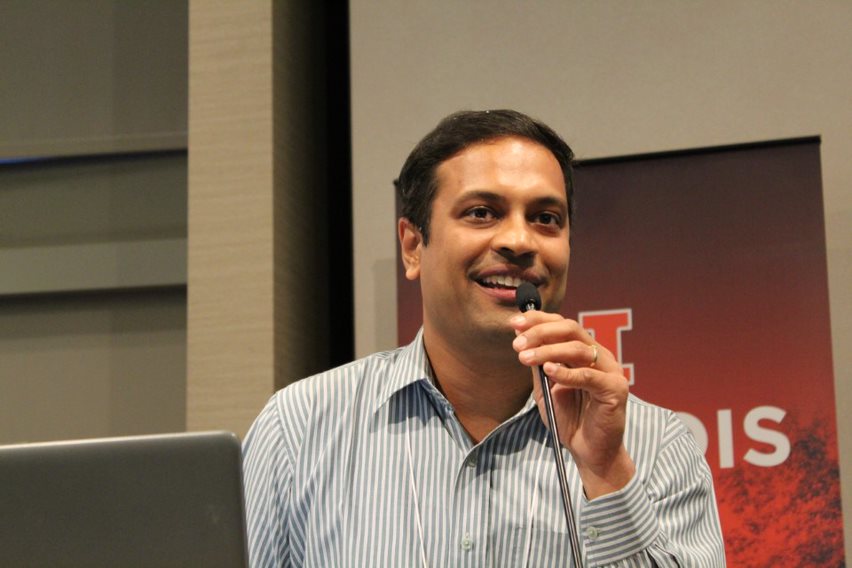
next speaker in our series is Ankush Goswami of IIT, Gandhinagar. Until recently, Ankush was a post-doc in Linz (Austria).
Talk Announcement:
Tea or Coffee: Please bring your own.
Organizers: Gaurav Bhatnagar (RamanujanExplained.org) , Atul Dixit (IIT, Gandhinagar), Bibekananda Maji (IIT, Indore), Krishnan Rajkumar (JNU) and Manjil Saikia (Ahmedabad University). Contact: sfandnt@gmail.com
The
next speaker in our series is Ankush Goswami of IIT, Gandhinagar. Until recently, Ankush was a post-doc in Linz (Austria).
Talk Announcement:
Tea or Coffee: Please bring your own.
The next speaker in our series is Siddhi Pathak, S. Chowla Research Assistant Professor, Penn State University. The talk announcement is below.
Talk Announcement:
Tea or Coffee: Please bring your own.
Abstract:We show that the series expansions of certain $q$-products have \textit{matching coefficients} with their inverses. Several of the results are associated to Ramanujan's continued fractions. For example, let $R(q)$ denote the Rogers-Ramanujan continued fraction having the well-known $q$-product repesentation $R(q)=\left(q,q^4;q^5\right)_{\infty}/\left(q^2,q^3;q^5\right)_{\infty}$. If
\begin{align*}
\sum_{n=0}^{\infty}\alpha(n)q^n=\dfrac{1}{R^5\left(q\right)}=\left(\sum_{n=0}^{\infty}\alpha^{\prime}(n)q^n\right)^{-1},\\
\sum_{n=0}^{\infty}\beta(n)q^n=\dfrac{R(q)}{R\left(q^{16}\right)}=\left(\sum_{n=0}^{\infty}\beta^{\prime}(n)q^n\right)^{-1},
\end{align*}
then
\begin{align*}
\alpha(5n+r)&=-\alpha^{\prime}(5n+r-2), \quad r\in\{3,4\}; \\ \text{and} & \\
\beta(10n+r)&=-\beta^{\prime}(10n+r-6), \quad r\in\{7,9\}.
\end{align*}
This is a joint work with Hirakjyoti Das.
The next speaker in our seminar is Shishuo Fu of Chongqing University, PRC. It may be Fool's day, but we're not kidding. It really is Shishuo who has consented to give a talk all the way from China!
The live broadcast did not work as anticipated in the previous talk; I hope it works this time. At any rate, its best to try and come for the zoom session.
Talk Announcement
Title: Bijective recurrences for Schroeder triangles and Comtet statistics
The next talk is by Christian Krattenthaler. I hope this time the live broadcast works. Here is the announcement.
Talk announcement
Title: Determinant identities for moments of orthogonal polynomials
Tea or Coffee: Please bring your own.
Abstract: We present a formula that expresses the Hankel determinants of a linear combination of length d+1 of moments of orthogonal polynomials in terms of a d x d determinant of the orthogonal polynomials. As a literature search revealed, this formula exists somehow hidden in the folklore of the theory of orthogonal polynomials as it is related to "Christoffel's theorem". In any case, it deserves to be better known and be presented correctly and with full proof. (During the talk I will explain the meaning of these somewhat cryptic formulations.) Subsequently, I will show an application of the formula. I will close the talk by presenting a generalisation that is inspired by Uvarov's formula for the orthogonal polynomials of rationally related densities.
Dear all,
We are happy to report that Atul Dixit, one of the co-organizers of this seminar, has been awarded the 2021 Gábor Szegö Prize. This prize is awarded every two years by the SIAM Activity Group on Orthogonal Polynomials and Special Functions (SIAG/OPSF). It is awarded to an early-career researcher for outstanding research contributions within 10 years of obtaining a Ph.D.
The selection committee in its letter to him cited his “impressive scientific work solving problems related to number theory using special functions, in particular related to the work of Ramanujan.”
Atul obtained his Ph.D. under the direction of Bruce Berndt in 2012 from the University of Illinois at Urbana-Champaign. Subsequently he did a post-doc at Tulane with Victor Moll as his mentor. Currently, he is in IIT, Gandhinagar and has quickly developed a reputation among young and upcoming mathematicians in this country that has attracted a bright set of Ph.D. students and post-docs to his team.
We wish Atul continued success, both personally and for the group he is leading.
Gaurav Bhatnagar and Krishnan Rajkumar (co-organizers with Atul of this seminar).
Links.
The next talk is by Liuquan Wang of Wuhan University.
Talk announcement
Title: Parity of coefficients of mock theta functions
Abstract: We study the parity of coefficients of classical mock theta functions. Suppose $g$ is a formal power series with integer coefficients, and let $c(g;n)$ be the coefficient of $q^n$ in its series expansion. We say that $g$ is of parity type $(a,1-a)$ if $c(g;n)$ takes even values with probability $a$ for $n\geq 0$. We show that among the 44 classical mock theta functions, 21 of them are of parity type $(1,0)$. We further conjecture that 19 mock theta functions are of parity type $(\frac{1}{2},\frac{1}{2})$ and 4 functions are of parity type $(\frac{3}{4},\frac{1}{4})$. We also give characterizations of $n$ such that $c(g;n)$ is odd for the mock theta functions of parity type $(1,0)$.
Tea or Coffee: Please bring your own.
ABSTRACT
We develop a calculus that gives an elementary approach to enumerate partition-like objects using an infinite upper-triangular number-theoretic matrix. We call this matrix the Partition-Frequency Enumeration (PFE) matrix. This matrix unifies a large number of results connecting number-theoretic functions to partition-type functions. The calculus is extended to arbitrary generating functions, and functions with Weierstrass products. As a by-product, we recover (and extend) some well-known recurrence relations for many number-theoretic functions, including the sum of divisors function, Ramanujan's $\tau$ function, sums of squares and triangular numbers, and for $\zeta(2n)$, where $n$ is a positive integer. These include classical results due to Euler, Ramanujan, and others. As one application, we embed Ramanujan's famous congruences $p(5n+4)\equiv 0\;$ (mod $5)$ and $\tau(5n+5)\equiv 0\; $ (mod $5)$ into an infinite family of such congruences.
This is joint work with Hartosh Singh Bal.
The next talk will be by Victor Moll of Tulane University. This will be the first mathematician from the US giving a talk in our seminar. Victor has kindly consented to stay awake to make his talk more suitable for Indian timings. But in future, we do expect speakers from the US will speak at times later at night (IST).
At any rate, we hope more speakers from the US will give talks in our seminar. As we have mentioned earlier, our website now contains video recordings of the presentations. This makes it more convenient for the US participants to view the talks.
Talk Announcement
Title: Valuations of interesting sequences
Speaker: Victor Moll (Tulane)
When: February 4, 2021 - 3:55 PM - 5:00 PM (IST)
Where: Google Meet; Please write to sfandnt@gmail.com if you want a link.
Tea or Coffee: Please bring your own.
ABSTRACT
Given a sequence ${ a_{n} }$ of integers and a prime $p$, the sequence of
valuation $\nu_{p}(a_{n})$ presents interesting challenges. This talk will discuss a
variety of examples in order to illustrate these challenges and present our approach
to this problem.
Our next talk is on January 21, 2021. Please do feel free to volunteer to speak, if you have submitted something recently and the topic is suitable for this group.
We have now upgraded the sf-and-nt website a bit. In case a video recording is available, we have embedded it, so you can view the recording at leisure. I wish to thank Shivam Sahu, a recent graduate of the math department of Ashoka University, for help in this activity. In particular, it will be of help when you are reading the associated papers in more detail. Any suggestions for the website are welcome.
The talk for the week is as follows.
Title: Elliptic and q-analogs of the Fibonomial numbers
Speaker: Josef Küstner (University of Vienna)
When: January 21, 2021 - 3:55 PM - 5:00 PM (IST)
Where: Google Meet; Please write to sfandnt@gmail.com if you want a link.
Tea or Coffee: Please bring your own.
ABSTRACT
The Fibonomial numbers are integer numbers obtained from the binomial coefficients by replacing each term by its corresponding Fibonacci number. In 2009, Sagan and Savage introduced a simple combinatorial model for the Fibonomial numbers.
In this talk, I will present a combinatorial description for a q-analog and an elliptic analog of the Fibonomial numbers which is achieved by introducing certain q- and elliptic weights to the model of Sagan and Savage.
This is joint work with Nantel Bergeron and Cesar Ceballos.
For the last seminar of the year, we are proud to host Rahul Kumar. He has recently defended his thesis in IIT, Gandhinagar under the direction of Atul Dixit, one of the co-organizers of this seminar. The announcement appears below.
Talk Announcement
Title: A generalized modified Bessel function and explicit transformations of certain Lambert series
Speaker: Rahul Kumar (IIT, Gandhinagar)
When: December 17, 2020 - 3:55 PM - 5:00 PM (IST)
Where: Google Meet; Please write to sfandnt@gmail.com if you want a link.
Tea or Coffee: Please bring your own.
ABSTRACT:
An exact transformation, which we call a master identity, is obtained for the series $\sum_{n=1}^{\infty}\sigma_{a}(n)e^{-ny}$ for $a\in\mathbb{C}$ and Re$(y)>0$. As corollaries when $a$ is an odd integer, we derive the well-known transformations of the Eisenstein series on $\text{SL}_{2}\left(\mathbb{Z}\right)$, that of the Dedekind eta function as well as Ramanujan's famous formula for $\zeta(2m+1)$. Corresponding new transformations when $a$ is a non-zero even integer are also obtained as special cases of the master identity. These include a novel companion to Ramanujan's formula for $\zeta(2m+1)$. Although not modular, it is surprising that such explicit transformations exist. The Wigert-Bellman identity arising from the $a=0$ case of the master identity is derived too. The latter identity itself is derived using Guinand's version of the Vorono\"{\dotlessi} summation formula and an integral evaluation of N.~S.~Koshliakov involving a generalization of the modified Bessel function $K_{\nu}(z)$. Koshliakov's integral evaluation is proved for the first time. It is then generalized using a well-known kernel of Watson to obtain an interesting two-variable generalization of the modified Bessel function. This generalization allows us to obtain a new transformation involving the sums-of-squares function $r_k(n)$. This is joint work with Atul Dixit and Aashita Kesarwani.
Dear all,
The next talk in the SF and NT seminar is by Sneha Chaubey. There will be one further talk in the Seminar this year, next week, and then we will take a short break.
Here is the announcement for Sneha's talk.
Talk announcement
Title: Generalized visible subsets of two dimensional integer lattice
Speaker: Sneha Chaubey (IIIT, Delhi)
When: December 10, 2020 - 3:55 PM - 5:00 PM (IST)
Where: Google Meet; Please write to sfandnt@gmail.com if you want a link.
Tea or Coffee: Please bring your own.
ABSTRACT: